
VOLUME 02 — SCOPE CREEP
It was one
small thing.
Then it was nine.
40 situations, from the first favour to resetting the whole deal. Each one already has the email written — and the two or three ways you could go, with what each one costs you.
The sample is the real file — one situation open, the other 39 listed, and the diagnostic quiz working on all 40.
SITUATION SC-1-1 — THE FIRST ONE
The first extra
sets the price.
One of the 40, printed in full. Nothing is held back for the paid version — this is what every situation looks like inside.
The situation
A one-off request just came in for something outside what the contract covers — the first time this has happened on this project.
Real riskLet the first out-of-scope ask slide without naming it, and “small extras are free” quietly becomes this client's assumption for every request after.
EVERY SITUATION HAS TWO OR THREE
You pick the tone.
The draft follows.
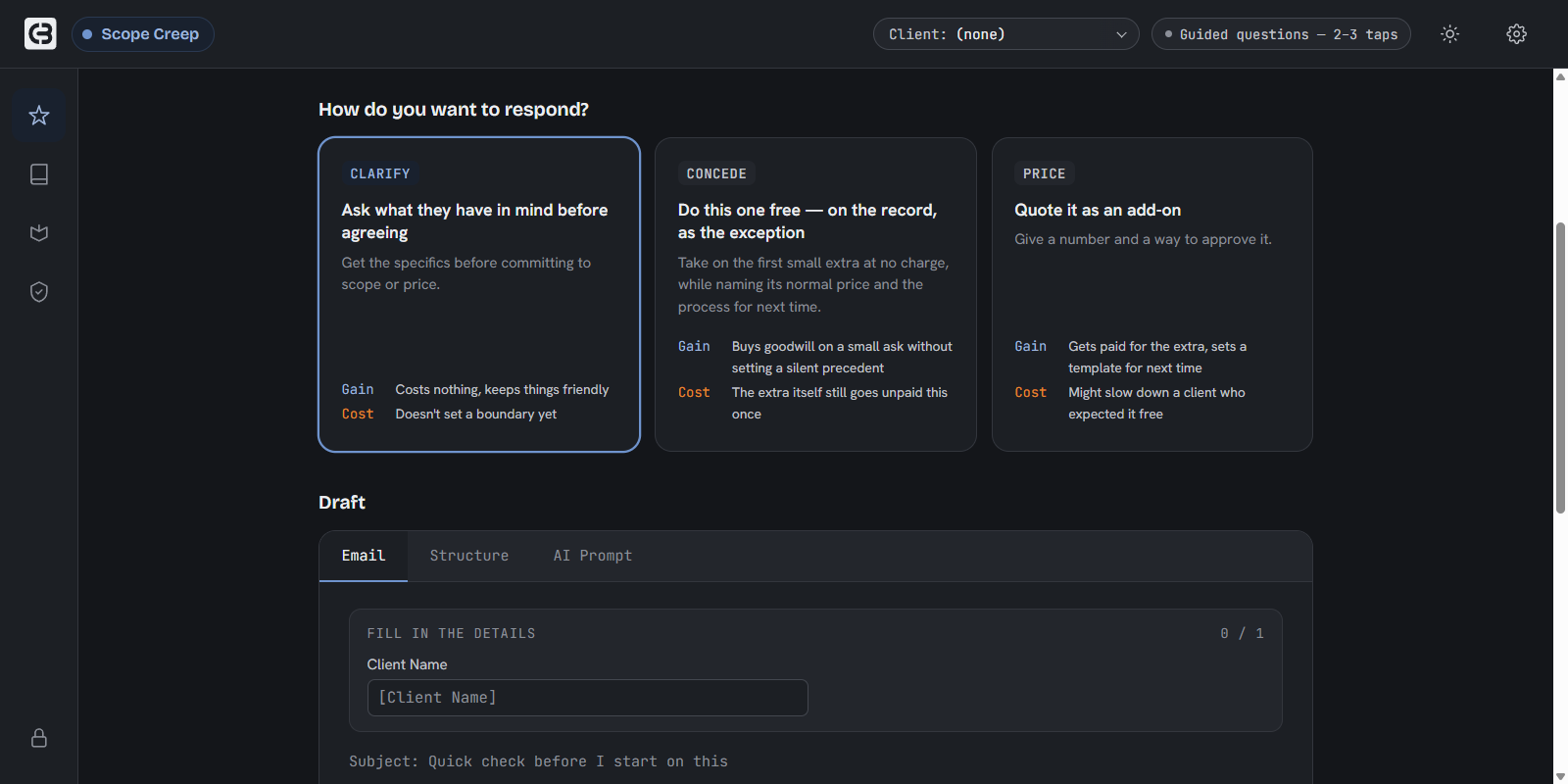
The same situation, three ways to answer it. Each one says what it gains you and what it costs — before you send anything.
Ask what they have in mind before agreeing
Get the specifics before committing to scope or price.
- Gain
- Costs nothing, keeps things friendly
- Cost
- Doesn't set a boundary yet
Do this one free — on the record, as the exception
Take on the first small extra at no charge, while naming its normal price and the process for next time.
- Gain
- Buys goodwill on a small ask without setting a silent precedent
- Cost
- The extra itself still goes unpaid this once
Quote it as an add-on
Give a number and a way to approve it.
- Gain
- Gets paid for the extra, sets a template for next time
- Cost
- Might slow down a client who expected it free
The draft above is the first one. The others are written out in full as well — all 98 of them are.
WHAT YOU OPEN
One file.
No account.
Double-click it and you are already here. Nothing installs, nothing signs in, and it keeps working with the wifi off.
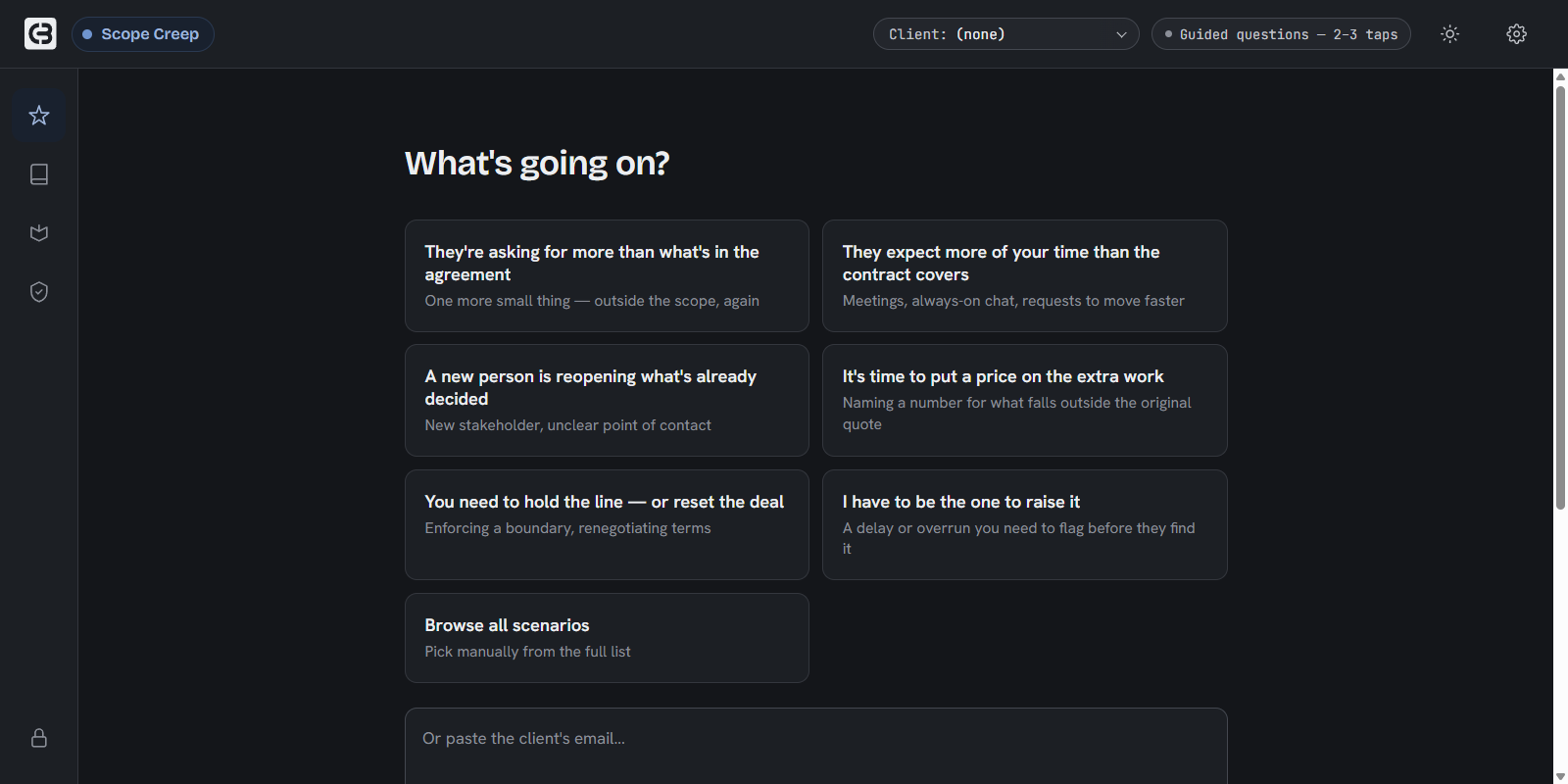
Pick the situation, or paste the client's email and let it work out which one you are in.
ALL 40 SITUATIONS
40 situations.
98 drafts.
The whole list, in the open. If your situation is not on it, this is not your volume — and that is worth knowing before you pay.
They're asking for more than what's in the agreement
One more small thing — outside the scope, again
7 SIT · 19 DRAFTS- A one-off request just came in for something outside what the contract covers — the first time this has happened on this project.
- A one-off request just came in for something outside the original scope — except there was never a contract, proposal, or scoped email to check it against in the first place.
- This is the third small out-of-scope request this month — each one reasonable alone, but they're stacking up.
- You've done a few small extras for free without saying anything, and now they've become the expectation — nothing about it was ever written down.
- With the project wrapping up, a bundle of extra requests just landed — all outside the signed scope — right as final payment is due.
- The client is asking for source files or broader usage rights than what the agreement covers — framed as a small, reasonable ask.
- Whether the completed project can be shown in a portfolio was only ever mentioned vaguely in conversation, with nothing specific agreed.
They expect more of your time than the contract covers
Meetings, always-on chat, requests to move faster
7 SIT · 18 DRAFTS- A quick call request turned into forty-five minutes of strategic advice — nothing about call length or scope was ever agreed on.
- The client has started expecting instant replies on chat, including evenings and weekends — nothing about response times was ever discussed, written or otherwise.
- The client has started routing their own tasks — pulling together assets, writing copy — your way, framed as 'just help me organize this.'
- The same deliverable keeps getting re-reviewed by different people on the client side, each with their own opinion — no one's confirmed who actually has final sign-off.
- The scope has grown over the last few weeks, but the original deadline is still on the table, unchanged.
- The client sat on feedback for two weeks, and now the original deadline is at risk — but the delay was entirely on their end.
- Every request lately comes marked 'urgent' — evenings, weekends, same-day — with no rush fee or agreement that any of this counts as expedited.
A new person is reopening what's already decided
New stakeholder, unclear point of contact
5 SIT · 14 DRAFTS- Requests are coming in from three different people on the client side, each one small, but nobody's tracking the total — and there's nothing written down about who's actually authorized to ask.
- A new stakeholder has joined the project and wants to revisit decisions that were already signed off weeks ago.
- Someone senior who wasn't part of earlier discussions has stepped in with a new set of requirements, treating them as if they were always part of the deal.
- A reorg on the client's side has shifted what the project is actually supposed to achieve — but you're still working from the original brief.
- You found out the deliverable is being used by a different team, or for a different purpose, than what the agreement licensed it for.
It's time to put a price on the extra work
Naming a number for what falls outside the original quote
6 SIT · 15 DRAFTS- You sent a quote for the extra work, and the reply pushes back with “isn't this part of what we're already paying for?”
- A quote for extra work is sitting unanswered, but the client keeps messaging as if the work is already underway.
- The client gave a verbal green light to start the extra work, but the price itself was left as 'we'll figure it out later.'
- Enough small extras have piled up that the fixed-price project is now running well past the hours it was originally priced for.
- The client wants to add scope but keep the current deadline exactly where it is — no acknowledgment that something has to give.
- Extra work already got done — informally agreed to over chat — and now it needs to actually get invoiced.
You need to hold the line — or reset the deal
Enforcing a boundary, renegotiating terms
5 SIT · 11 DRAFTS- A request has come in for more free work, and this time there's a clear, signed contract that says it's out of scope.
- You need to hold a real boundary on further free work, but the only agreement in place was a conversation — nothing in writing backs it up.
- Extra work is ready to continue, but approval on the added item's estimate hasn't come through — and you're ready to walk away from this client if it comes to that.
- After pushing back on a request, the client says they'll just find someone else who'll do it.
- Scope has crept enough times that the original terms of the engagement no longer reflect how the work actually runs — it's time to reset them formally.
I have to be the one to raise it
A delay or overrun you need to flag before they find it
3 SIT · 7 DRAFTS- Partway through the project, it's become clear the work will exceed the original estimate — and you need to tell the client before it happens, not after.
- You already flagged one cost overrun on this project, and now a second one is becoming clear.
- A delivery date you committed to isn't going to hold — the slip is on your side, and the client doesn't know yet.
Before it starts
Settling it while nothing has gone wrong yet
7 SIT · 14 DRAFTS- The kickoff call covered scope in detail — but only out loud. Nothing from that conversation made it into anything either of you can point back to.
- The client sent over their own contract or PO to sign — and the scope section is written broadly enough to mean almost anything.
- The client wants to start immediately and 'figure out the details as we go' — before anything about scope is written down.
- An estimate request came in, but it's too vague to actually price — no clear deliverables, just a general idea.
- The project hasn't started yet, and there's a chance to set expectations for how out-of-scope requests will be handled before any actually come up.
- Before any contract exists, the prospective client is asking for a free sample or a highly detailed proposal to 'see your approach' first.
- Work already began on an informal basis, and now scope needs to get pinned down after the fact, with no contract in place.
WHEN ONE VOLUME IS NOT THE SHAPE OF IT
Scope creep rarely
travels alone.
The client who keeps adding is often the same one who pays late, then goes quiet when you invoice for it. Six volumes, in one file that keeps a single history per client, is a different tool — not this one with extras.
BEFORE YOU BUY
Straight
answers.
What do I actually receive?
One HTML file. Open it in any browser — no install, no account, no login. Keep a copy and it keeps working, with or without us.
Does an AI write the emails?
No. All 98 drafts are written in advance. If your browser has on-device AI, you can paste the client's email and it works out which situation you are in. Without it, two or three taps get you to the same place.
I do want to keep this client. Is this too firm?
No. Most of the 40 are written for exactly that — holding the line while keeping the relationship. Only the last group is for when it has to stop.
The extras were agreed over chat, not in the contract.
Seven of the situations are about that specifically: turning an informal yes into something you can invoice, and getting the record built after the fact.
I might want the other volumes later.
Then start here anyway. If you get the System afterwards, this $25 comes off it — email hello@useclearbound.com from the address you bought with and we will take it off. Starting small costs you nothing extra.
Does my data go anywhere?
No. What you type stays in your browser on your machine. There is no account and no server, so there is nowhere for it to go.
Who wrote these?
Jay — twenty years freelancing, now running a one-person agency. Not a template pack bought and rebranded: these are the replies worked out over those years, then written down properly. More on the about page.
PRICE
One unpaid extra
pays for it.
The Scope Creep Playbook
- 40 situations — from the first sign to the last resort, for when the work keeps growing
- 98 drafts, each one written out in full
- Two or three approaches per situation, with what each costs
- 7 to settle before the work starts
- One HTML file · works offline · no account · yours forever
Upgrading to the System later? This $25 comes off it.
VOLUME 02 — SCOPE CREEP
Say yes
on purpose.
40 situations and 98 drafts for work that keeps growing. Opens in any browser and stays yours.