
VOLUME 01 — GETTING PAID
The due date
passed.
Now what do you send?
22 situations, from the first missed date to a flat refusal. Each one already has the email written — and the two or three ways you could go, with what each one costs you.
The sample is the real file — one situation open, the other 21 listed, and the diagnostic quiz working on all 22.
SITUATION GP-1-1 — DAY ONE
The cheapest day
is today.
This is one of the 22, printed in full. Nothing is held back for the paid version — this is what every situation looks like inside.
The situation
The invoice's due date passed today. You haven't sent anything yet, and the client hasn't reached out either.
Real riskLet the first missed due date pass without comment, and “sometime after the due date” quietly becomes this client's normal.
EVERY SITUATION HAS TWO OR THREE
You pick the tone.
The draft follows.
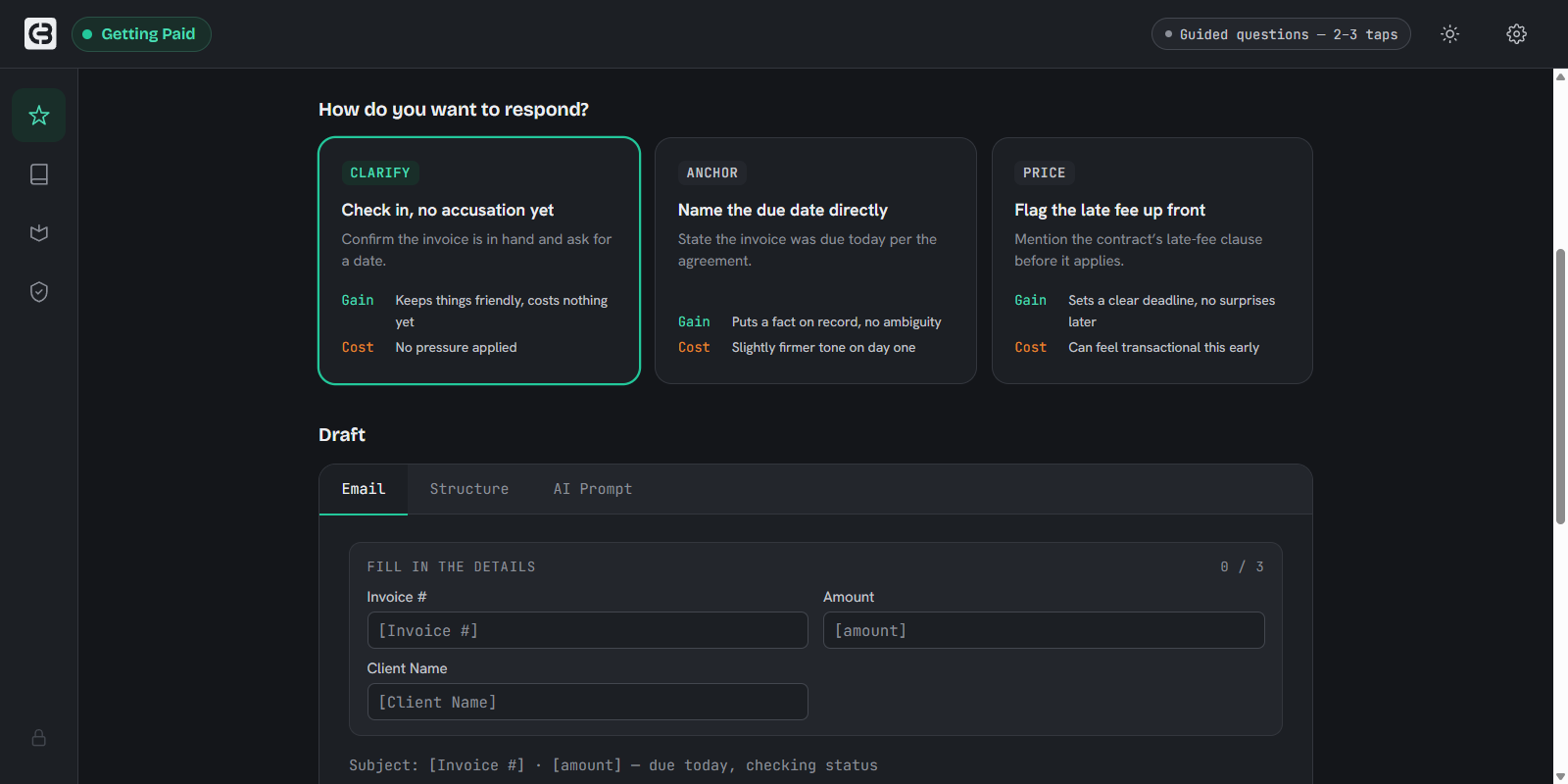
The same situation, three ways to answer it. Each one says what it gains you and what it costs — before you send anything.
Check in, no accusation yet
Confirm the invoice is in hand and ask for a date.
- Gain
- Keeps things friendly, costs nothing yet
- Cost
- No pressure applied
Name the due date directly
State the invoice was due today per the agreement.
- Gain
- Puts a fact on record, no ambiguity
- Cost
- Slightly firmer tone on day one
Flag the late fee up front
Mention the contract's late-fee clause before it applies.
- Gain
- Sets a clear deadline, no surprises later
- Cost
- Can feel transactional this early
The draft above is the first one. The other two are written out in full as well — all 49 of them are.
WHAT YOU OPEN
One file.
No account.
Double-click it and you are already here. Nothing installs, nothing signs in, and it keeps working with the wifi off.
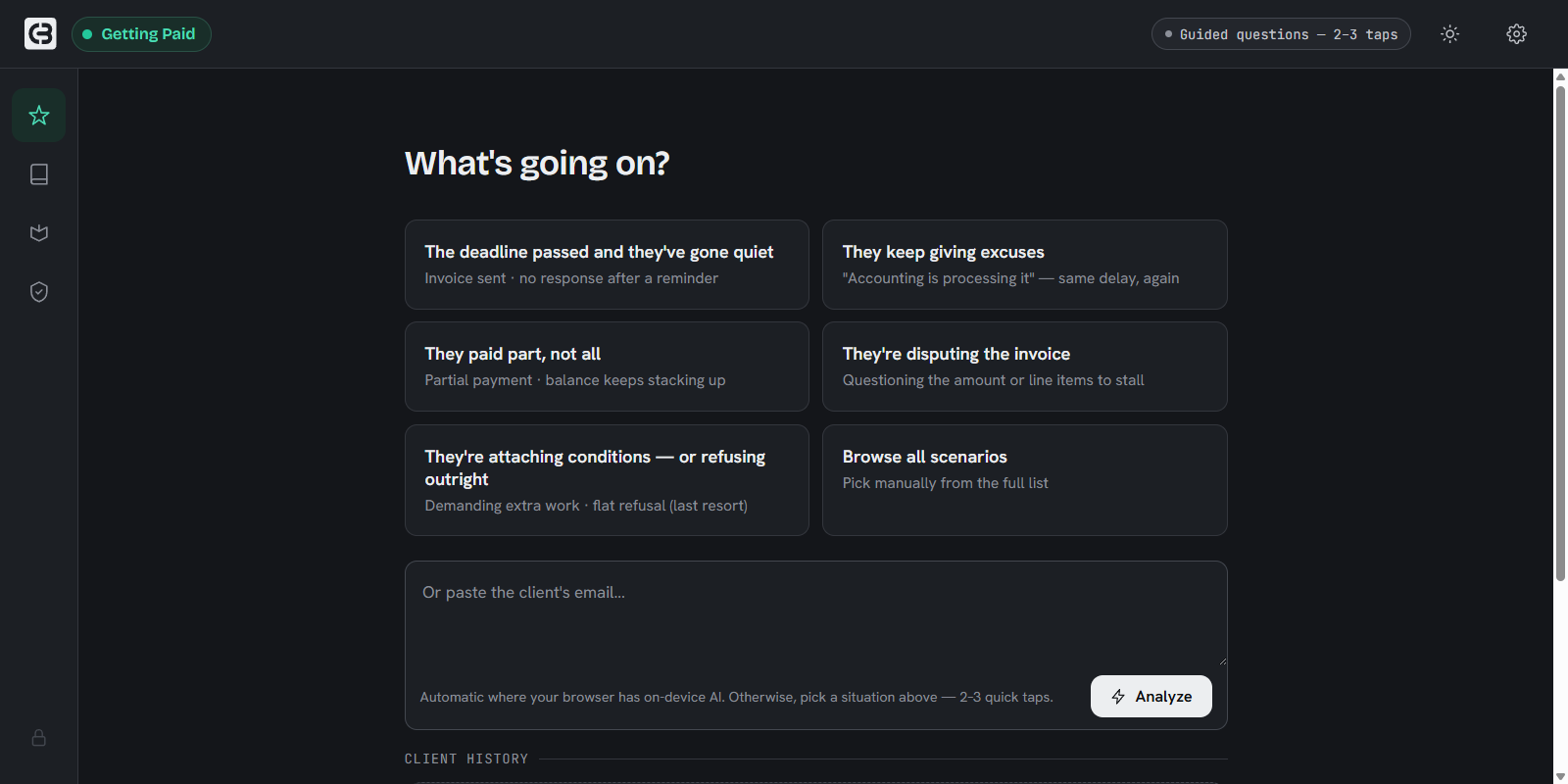
Pick the situation, or paste the client's email and let it work out which one you are in.
ALL 22 SITUATIONS
22 situations.
49 drafts.
The whole list, in the open. If your situation is not on it, this is not your volume — and that is worth knowing before you pay.
The deadline passed and they've gone quiet
Invoice sent · no response after a reminder
5 SIT · 13 DRAFTS- The invoice's due date passed today. You haven't sent anything yet, and the client hasn't reached out either.
- The invoice is past due, you already sent a reminder, and the client still hasn't responded. The first nudge is behind you — it's time to decide what comes next.
- You started this project on a verbal agreement — no signed contract — and the due date you two discussed has now passed.
- The project ran on a verbal agreement, the discussed due date has passed, and your first reminder got no answer.
- You've sent three reminders now — the original invoice plus two follow-ups — and there's still been no response at all.
They keep giving excuses
"Accounting is processing it" — same delay, again
4 SIT · 8 DRAFTS- The client responded to your invoice with "Accounting is processing it" — no date attached.
- You heard the same vague excuse a second time — still no date attached.
- The excuses keep coming, and you realize the payment terms themselves were only ever agreed verbally.
- The client answered your payment request with "accounting is processing it" — and this project has only ever run on a verbal agreement.
They paid part, not all
Partial payment · balance keeps stacking up
2 SIT · 4 DRAFTS- The client paid half the invoice and said the rest would come "later" — no date given.
- Partial payments have become the pattern — each invoice comes in split, and the unpaid balance keeps growing across projects.
They're disputing the invoice
Questioning the amount or line items to stall
2 SIT · 4 DRAFTS- The client is disputing specific line items on the invoice and withholding payment on the entire amount until it's resolved.
- The dispute isn't really about the invoice math — it's a disagreement over what was verbally agreed to include.
They're attaching conditions — or refusing outright
Demanding extra work · flat refusal (last resort)
4 SIT · 10 DRAFTS- The client is refusing to pay at all, and the only agreement you ever had was a verbal one — nothing signed.
- The client says payment will move once you've "wrapped up" a few extras that were never part of the deal — and the deal itself was only ever verbal. You'd still like to keep them.
- The client says they'll release final payment only once you complete additional work that wasn't part of the original agreement.
- The client has flatly refused to pay [Invoice #] at all.
Before it starts
Five things to settle while nothing has gone wrong yet
5 SIT · 10 DRAFTS- The client wants to start right away, before any deposit has come up. Neither of you has mentioned one, because it feels awkward to bring up before any work exists to point to.
- The client sends over their own services agreement to sign. The payment section just says the invoice is due upon completion — no amount breakdown, no schedule, no deposit.
- You agreed on price and timeline over a call, but late payment never came up. There's no mention anywhere of what happens if an invoice goes unpaid past its due date.
- This is your third project with a client who's paid late on both of the first two. Nothing about deposits, schedules, or late fees has ever been written down between you.
- The late-payment pattern has continued despite raising it before, and you're ready to make upfront payment a condition of taking on more work.
WHEN ONE VOLUME IS NOT THE SHAPE OF IT
Late money rarely
travels alone.
The client who pays late is often the same one who added work without asking, then went quiet. Six volumes, in one file that keeps a single history per client, is a different tool — not this one with extras.
BEFORE YOU BUY
Straight
answers.
What do I actually receive?
One HTML file — in practice, a mini-site saved on your device. It opens in any browser, online or offline; no install, no account, no login. Keep a copy and it keeps working, with or without us.
Does an AI write the emails?
No. All 49 drafts are written in advance. If your browser has on-device AI, you can paste the client's email and it works out which situation you are in. Without it, two or three taps get you to the same place.
Can it work with ChatGPT or Claude?
Yes — the last chapter, Install in your AI, copies an install prompt that teaches your AI this file's method: the nine strategies, the decision matrix, and the full map of all 22 situations. Your AI then covers what we couldn't write down — your client, your wording — and points you back here when the finished draft already exists. The drafts themselves stay in the file.
Is this legal advice?
No. Where a situation touches late fees, collections or contract terms, the file says so plainly and tells you what to check in your own agreement. That is information, not advice.
My contract was only ever verbal. Is this still for me?
Yes — the situations that assume a verbal-only agreement are written for exactly that, including how to turn the conversation you had into a record you can point at later.
I might want the other volumes later.
Then start here anyway. If you get the System afterwards, this $18 comes off it — email hello@useclearbound.com from the address you bought with and we will take it off. Starting small costs you nothing extra.
Does my data go anywhere?
No. What you type stays in your browser on your machine. There is no account and no server, so there is nowhere for it to go.
Who wrote these?
Jay — twenty years freelancing, now running a one-person agency. Not a template pack bought and rebranded: these are the replies worked out over those years, then written down properly. More on the about page.
PRICE
One invoice
pays for it.
The Getting Paid Playbook
- 22 situations — first missed date to flat refusal
- 49 drafts, each one written out in full
- Two or three approaches per situation, with what each costs
- Five to settle before the work starts
- One HTML file · works offline · no account · yours forever
Upgrading to the System later? This $18 comes off it.
VOLUME 01 — GETTING PAID
Ask once,
properly.
22 situations and 49 drafts for the money that has not arrived. Opens in any browser and stays yours.