
VOLUME 05 — LOWBALL
The number
was fine
until they said it.
29 situations, from a budget named before any scope to a discount that was supposed to be one time. Each one already has the email written — and the two or three ways you could go, with what each one costs you.
The sample is the real file — one situation open, the other 28 listed, and the diagnostic quiz working on all 29.
SITUATION LB-1-1 — THE PUSHBACK
A number defended
once holds.
One of the 29, printed in full. Nothing is held back for the paid version — this is what every situation looks like inside.
The situation
A quote was sent with a clear number, and the reply pushes back — either asking for a lower number directly, or pointing out another freelancer would charge less. This is the first time pricing has come up with this client.
Real riskLower the number without a reason and this quote becomes the starting point for every negotiation after it, not the price.
EVERY SITUATION HAS TWO OR THREE
You pick the tone.
The draft follows.
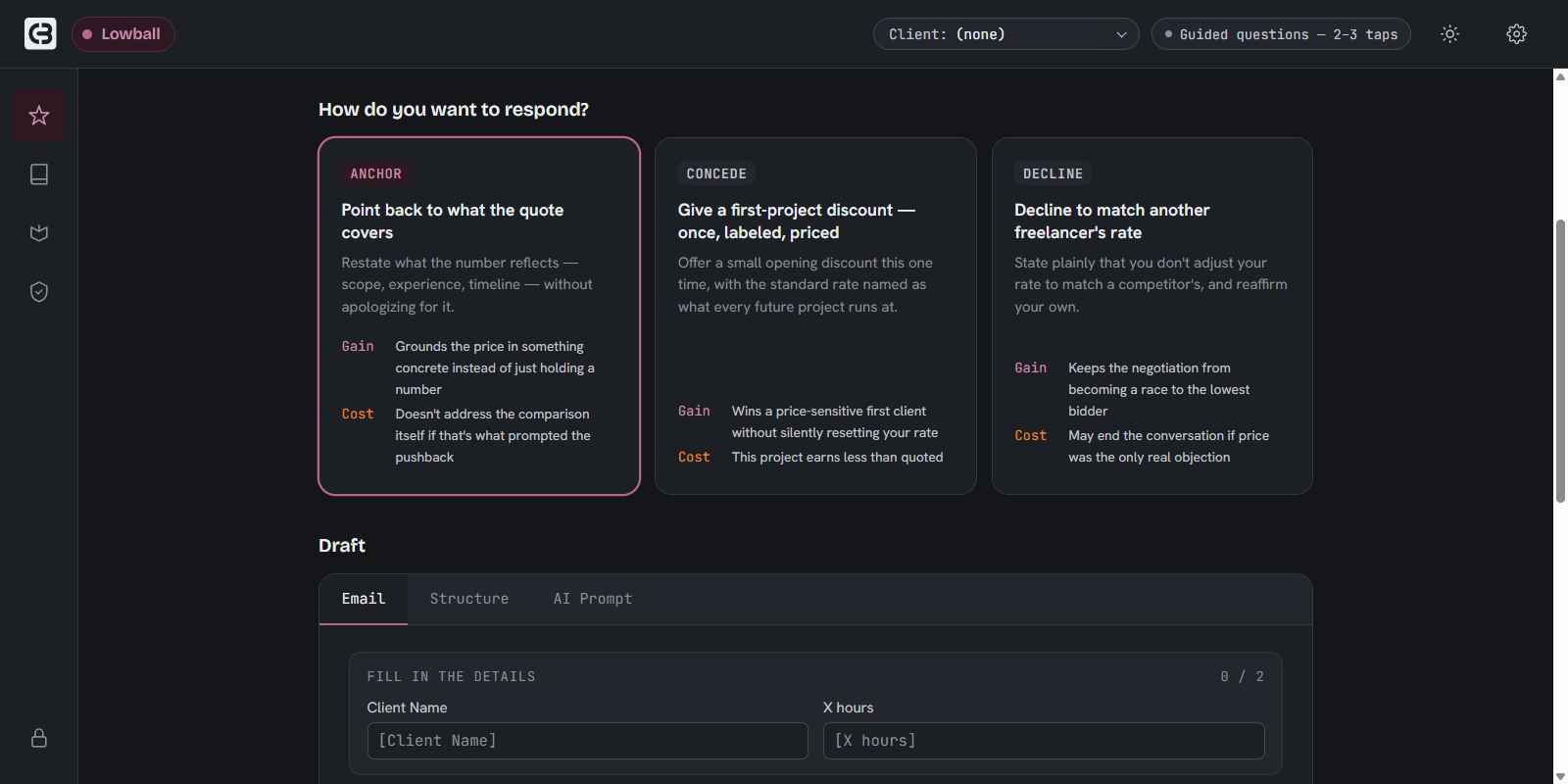
The same situation, three ways to answer it. Each one says what it gains you and what it costs — before you send anything.
Point back to what the quote covers
Restate what the number reflects — scope, experience, timeline — without apologizing for it.
- Gain
- Grounds the price in something concrete instead of just holding a number
- Cost
- Doesn't address the comparison itself if that's what prompted the pushback
Give a first-project discount — once, labeled, priced
Offer a small opening discount this one time, with the standard rate named as what every future project runs at.
- Gain
- Wins a price-sensitive first client without silently resetting your rate
- Cost
- This project earns less than quoted
Decline to match another freelancer's rate
State plainly that you don't adjust your rate to match a competitor's, and reaffirm your own.
- Gain
- Keeps the negotiation from becoming a race to the lowest bidder
- Cost
- May end the conversation if price was the only real objection
The draft above is the first one. The others are written out in full as well — all 83 of them are.
WHAT YOU OPEN
One file.
No account.
Double-click it and you are already here. Nothing installs, nothing signs in, and it keeps working with the wifi off.
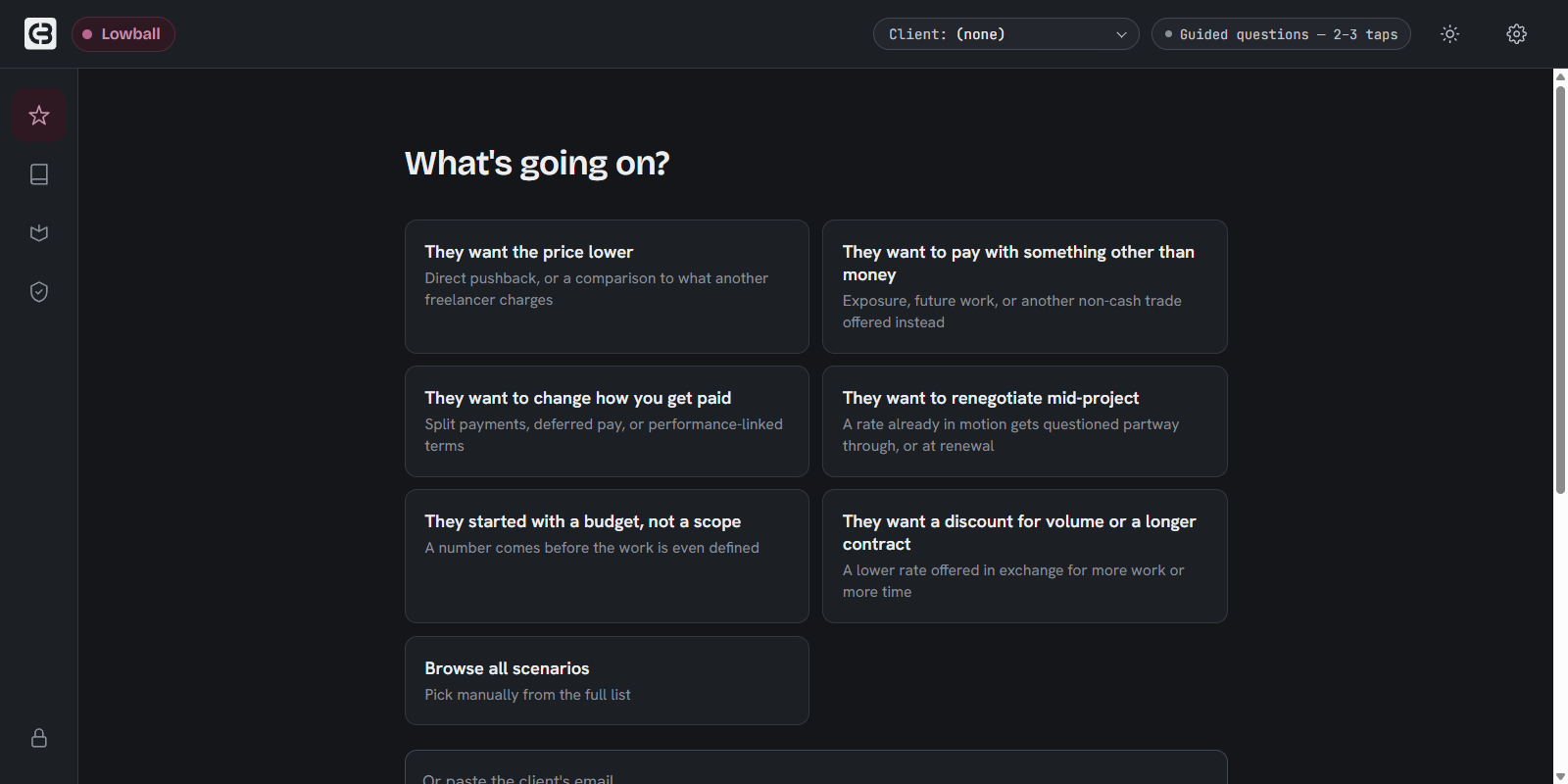
Pick the situation, or paste the client's email and let it work out which one you are in.
ALL 29 SITUATIONS
29 situations.
83 drafts.
The whole list, in the open. If your situation is not on it, this is not your volume — and that is worth knowing before you pay.
They want the price lower
Direct pushback, or a comparison to what another freelancer charges
6 SIT · 18 DRAFTS- A quote was sent with a clear number, and the reply pushes back — either asking for a lower number directly, or pointing out another freelancer would charge less. This is the first time pricing has come up with this client.
- Before a number has even been discussed, the client brings up budget concerns and pushes to have a lower rate locked in ahead of the actual quote.
- This client got a discount on the last project, and now a new project comes with the same request for a lower rate.
- This client has asked for a lower rate more than once, but every past agreement on rate happened in conversation — nothing about pricing has ever been written down.
- The rate has been pushed down repeatedly across past projects, and this time the request comes again — but continuing at this rate no longer makes the relationship worth it.
- Requests to lower the rate have kept coming and this feels like the limit — but this is a client worth keeping if there's a way to hold the rate without ending things.
They want to pay with something other than money
Exposure, future work, or another non-cash trade offered instead
3 SIT · 9 DRAFTS- Instead of paying, the client offers something else — exposure, a portfolio mention, or a promise of bigger work down the line. No number has been discussed yet.
- A non-monetary trade was already made once before — discussed verbally, nothing written down — and now a similar offer comes again for a new project.
- A quote with a real number was already sent, and the reply proposes trading that payment for something non-monetary instead.
They want to change how you get paid
Split payments, deferred pay, or performance-linked terms
4 SIT · 12 DRAFTS- A quote is on the table, and the client proposes paying half upfront with the rest contingent on how the results turn out — with no specifics on what "results" means.
- The client asks for an unusually large number of installments — well beyond what's typical — that would spread payment out much further than normal.
- This is now the second project where split or deferred payment terms have come up, and each time it's been handled as a one-off exception.
- Requests to adjust payment terms have kept happening, and trust in getting paid on time has worn thin enough that the upfront portion needs to change.
They want to renegotiate mid-project
A rate already in motion gets questioned partway through, or at renewal
4 SIT · 12 DRAFTS- Partway through an ongoing retainer, the client asks — out of nowhere, mid-contract — to lower the rate starting next month because their budget has shrunk.
- The rate for this retainer was only ever agreed verbally, and the next invoice comes in lower than what was actually discussed.
- Requests to lower this retainer's rate have kept happening, and this feels like the limit — but this is a client worth restructuring the relationship for rather than losing outright.
- The retainer is coming up for its scheduled renewal, and the client wants to use the renewal conversation to negotiate the rate down.
They started with a budget, not a scope
A number comes before the work is even defined
5 SIT · 15 DRAFTS- A quote has already gone out, and the client comes back with a fixed budget number, asking to fit the same deliverables within it.
- The client keeps lowering the stated budget on repeated asks, while refusing to let the deliverables shrink to match.
- Before any scope has been discussed, the client leads with a fixed budget number and asks what can be done within it.
- Budget pressure has come up repeatedly on this account, and it's reached the point where continuing to work under these constraints isn't worth it.
- The client's budget got cut, and they're asking you to reduce scope to fit the new number — but haven't said what should actually come out.
They want a discount for volume or a longer contract
A lower rate offered in exchange for more work or more time
3 SIT · 9 DRAFTS- A quote has been sent, and the client offers to commit to a longer contract — six months, say — in exchange for a lower rate.
- A volume discount was already agreed to and applied, but the promised volume of work hasn't actually materialized.
- The volume discount promise has been broken more than once now, and continuing to extend it isn't sustainable — this relationship is at its limit.
Before it starts
Settling it while nothing has gone wrong yet
4 SIT · 8 DRAFTS- The quote hasn't gone out yet, and there's no plan in place for documenting what it's based on — scope, hours, or market rate.
- The client's contract or onboarding materials cover scope and deliverables in detail, but say nothing about payment method — whether non-monetary trades would ever be acceptable.
- During early conversations, there's been a vague verbal mention of "figuring out a good rate for future work," but nothing about the rate for this project has been put in writing.
- This is a new project with a client who's pushed to lower the rate on more than one past project. Nothing about the rate for this new project has been said yet.
WHEN ONE VOLUME IS NOT THE SHAPE OF IT
The discount is
rarely the last ask.
The client who talks the rate down often adds work later, then pays slowly. Six volumes, in one file that keeps a single history per client, is a different tool — not this one with extras.
BEFORE YOU BUY
Straight
answers.
What do I actually receive?
One HTML file — in practice, a mini-site saved on your device. It opens in any browser, online or offline; no install, no account, no login. Keep a copy and it keeps working, with or without us.
Does an AI write the emails?
No. All 83 drafts are written in advance. If your browser has on-device AI, you can paste the client's email and it works out which situation you are in. Without it, two or three taps get you to the same place.
Can it work with ChatGPT or Claude?
Yes — the last chapter, Install in your AI, copies an install prompt that teaches your AI this file's method: the nine strategies, the decision matrix, and the full map of all 29 situations. Your AI then covers what we couldn't write down — your client, your wording — and points you back here when the finished draft already exists. The drafts themselves stay in the file.
They offered exposure instead of money.
Three situations cover non-cash offers — exposure, future work, equity-ish promises — and how to decline without insulting anyone.
The rate is already agreed and they want it changed mid-project.
Four situations are about exactly that, including renewals where the number quietly gets questioned again.
I might want the other volumes later.
Then start here anyway. If you get the System afterwards, this $22 comes off it — email hello@useclearbound.com from the address you bought with and we will take it off. Starting small costs you nothing extra.
Does my data go anywhere?
No. What you type stays in your browser on your machine. There is no account and no server, so there is nowhere for it to go.
Who wrote these?
Jay — twenty years freelancing, now running a one-person agency. Not a template pack bought and rebranded: these are the replies worked out over those years, then written down properly. More on the about page.
PRICE
One held rate
pays for it.
The Lowball Playbook
- 29 situations — from the first sign to the last resort, for when the number is too low
- 83 drafts, each one written out in full
- Two or three approaches per situation, with what each costs
- 4 to settle before the work starts
- One HTML file · works offline · no account · yours forever
Upgrading to the System later? This $22 comes off it.
VOLUME 05 — LOWBALL
Hold the number.
Keep the room.
29 situations and 83 drafts for the conversation about price. Opens in any browser and stays yours.